Have you ever played a game where everyone has to keep track of points, and nobody is allowed to cheat? What if I told you that there’s a digital way to keep track of important stuff like money, votes, or ownership, and no one can cheat or lie? That’s where blockchain comes in.
What is Blockchain?
Let’s start with the basics. A blockchain is like a special notebook that anyone can look at, but no one can erase or change what’s already written. Instead of one person holding the notebook, lots of people have copies of it. This notebook keeps a record of all kinds of things like:
-
Who sent money to whom
-
Who owns which digital item
-
When a contract was made
Imagine it like a digital LEGO tower. Every new block (or brick) you add has information. Once it’s added, it locks in place and becomes part of the tower forever.
Read More: cashstark com
Why is Blockchain Special?
You may be wondering, “Why not just use a regular computer or website?” That’s a great question!
Most things today are controlled by one person or company. For example:
-
Banks keep records of your money
-
Social media sites control your profile
-
Game companies control your scores and items
But what if those places get hacked or make a mistake? That’s the problem blockchain helps fix. The answer to how does blockchain work lies in how it shares control across many people instead of one central boss.
Blocks, Chains, and How They Work Together
Now let’s break it down.
-
Block: This is like a page in the notebook. It holds some information—like a list of money transfers or who owns what.
-
Chain: This connects the blocks in a straight line, one after another. Once a block is added, it links to the one before it. Like a train with connected cars.
-
Forever Record: You can’t go back and change a block without changing the whole chain, which is almost impossible.
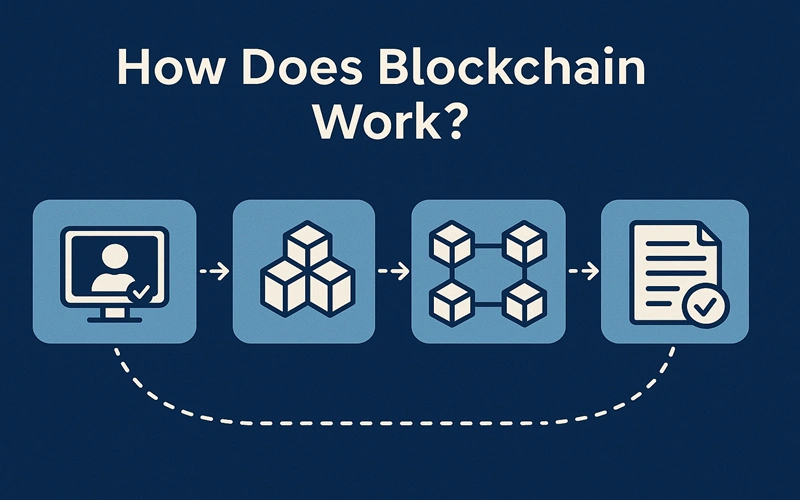
So, the simple answer to how does blockchain work is: data is added in blocks, those blocks are chained together, and everyone can see the same chain. No one can cheat without everyone knowing.
Who Checks the Blockchain?
In a regular bank, people check transactions. In blockchain, special computers do this job. They are called nodes. Each node has a copy of the whole blockchain.
Before a new block is added, all the nodes must agree that it’s correct. This is called consensus—a fancy word that means “we all agree.”
To make sure the block is valid, the nodes solve very hard math problems. This is called mining in some blockchains like Bitcoin. The first computer to solve the problem gets to add the new block and wins a reward.
Still wondering how does blockchain work with so many computers? Well, they work together by checking and agreeing on the data. Once they agree, it gets added to the chain.
What Can Blockchain Be Used For?
You might think blockchain is just for cryptocurrency like Bitcoin. But guess what? That’s just the beginning! Here are some cool things people are using blockchain for:
-
Money Transfers: Faster and cheaper than banks
-
Digital Art: With NFTs, people sell art that’s tracked on the blockchain
-
Gaming: Own your digital items forever
-
Voting: Safer and harder to cheat
-
Medical Records: Patients keep track of their own data
When people ask how does blockchain work, they often only think of money. But it’s actually useful for almost anything where keeping records matters.
Is Blockchain Safe?
Yes, blockchain is very safe. But how?
-
No one can change the past: Once something is written, it stays forever.
-
Everyone has a copy: So no one can lie or cheat.
-
Very hard to hack: You’d need to control most of the computers in the system to change anything.
That’s why people trust blockchain. It doesn’t depend on one person or company—it depends on math, rules, and teamwork.
Are There Any Problems?
Nothing is perfect. While the answer to how does blockchain work is exciting, there are a few problems too:
-
Energy Use: Some blockchains (like Bitcoin) use a lot of electricity
-
Speed: Some are slower than normal websites or banks
-
Scams: Just like on the internet, some people try to trick others
But developers are working hard to fix these. Many new blockchains use eco-friendly systems that don’t need as much power. Others are finding ways to be faster and safer.
Private vs. Public Blockchains
There are two types of blockchains:
-
Public: Anyone can join and see the data. (Like Bitcoin)
-
Private: Only certain people can access it. (Like a business using it to track products)
Both types use the same basic idea. So whether someone asks about a public or private chain, the question is still how does blockchain work—and the answer is: by linking data in blocks, checking it together, and never allowing changes to past records.
Real Life Example: How Does Blockchain Work in a Game?
Let’s say you play a game and win a magical sword. In a regular game, the game company controls your sword. If they shut down the game, it’s gone.
But with blockchain, your sword is stored in a block. It’s yours forever. Even if the game goes away, the sword is still recorded on the blockchain. You can even sell or trade it in other games that support the same system!
That’s a fun way to understand how does blockchain work in your daily life.
The Future of Blockchain
More and more people are learning about blockchain every day. In the future, we might use it for:
-
Renting cars
-
Proving who owns land or a house
-
Sharing music and making sure artists get paid
It’s like building a world where people trust computers and each other—without needing big companies to keep everything.
The big idea behind how does blockchain work is that it helps people share things in a safe, honest, and digital way.
Final Thoughts
Let’s review everything in one simple sentence: Blockchain works by recording information in blocks, connecting them in a chain, and having many people check that everything is fair.
Now when someone asks you, how does blockchain work, you’ll be able to tell them it’s like a magical notebook that everyone can trust!
FAQs
1. What is the main purpose of blockchain?
The main purpose is to keep records that are safe, honest, and can’t be changed. It helps people share digital things without needing to trust just one person or company.
2. Is blockchain the same as Bitcoin?
No, Bitcoin is just one example of using blockchain. Blockchain is the technology behind it, and it can be used for many other things like games, art, or voting.
3. Can someone hack the blockchain?
It’s very hard to hack because many computers check and agree on every change. Changing something would mean hacking most of those computers at once, which is nearly impossible.
Read More: uploadarticle.com