A SaaS founder I know spent $180,000 on a mobile app that essentially replicated her web product on a smaller screen. Same features, same information architecture, same flows just shrunk to fit a phone. Users downloaded it because she asked them to. Most used it once, noticed it was harder to navigate than the website, and went back to the browser.
She didn’t need a $180,000 app. She needed a $60,000 app that did the three things her users actually wanted to do on mobile check a status, get a notification, approve something quickly and did those three things extraordinarily well. The expensive version tried to do everything. The version that would have worked tried to do the right things.
That’s the most expensive way businesses overspend on mobile development: building more than the use case requires. A good Mobile app development company will tell you this before you sign anything. Many won’t, because more scope means more revenue for them. Understanding the specific strategies that reduce mobile development costs without reducing what users actually need is how you avoid paying for the expensive version of an app when the focused version would have served you better.
Start With the Use Case, Not the Feature List
The first and highest-leverage cost reduction strategy happens before a single line of code exists: narrowing what the app is actually supposed to do.
Mobile apps that try to replicate a full web or desktop product on a smaller screen fail for two reasons simultaneously. They’re expensive to build because every feature requires mobile-specific implementation and they’re worse experiences than the original, because the interaction patterns of a desktop product don’t translate cleanly to touch interfaces. Both failures cost money: the build cost and the eventual cost of addressing poor engagement.
The productive question isn’t “what features does our product have that should also be in the app.” It’s “what are the two or three things users would want to do from a phone rather than a desktop, and what does doing those things well require.” The answers to those questions define a scope that’s fundamentally smaller and more focused than the full product feature set and that focused scope builds faster, costs less, and serves mobile users better.
Every feature added to an app build adds cost in ways that compound. Design work for the feature. Development of the feature. Testing the feature across devices and OS versions. Bug fixes when the feature interacts unexpectedly with other features. Documentation. Ongoing maintenance as platform updates affect it. A feature that costs $5,000 to build has a total lifecycle cost that’s considerably higher. Cutting features that mobile users don’t actually need removes that compounding cost before it accumulates.
Platform Sequencing Changes the Economics Significantly
Building for iOS and Android simultaneously doubles a specific category of costs: design adaptation for platform conventions, QA across two platform environments, and the ongoing maintenance of two separate implementations of the same logic.
For most apps serving markets where the user base is not evenly split between platforms which is most apps the economics of launching one platform first are straightforwardly better than building both simultaneously. The platform-one build validates whether the core product assumptions hold. The feedback from real users on platform one informs the platform-two build in ways that make it better and often faster to produce. The total cost of building both platforms sequentially is often lower than building them in parallel, because the parallel build pays coordination overhead that sequential development avoids.
Choosing which platform to build first should follow from where the target users are, not from team preference or personal device use. Consumer apps targeting North American users have a reasonable argument for iOS-first given platform distribution in that market. Apps targeting global or emerging market users where Android’s share runs above eighty percent in many markets have the opposite argument. Getting this choice right is free. Getting it wrong costs the additional platform build at a moment when resources are already stretched.
Cross-Platform Frameworks as a Cost Tool Used Correctly
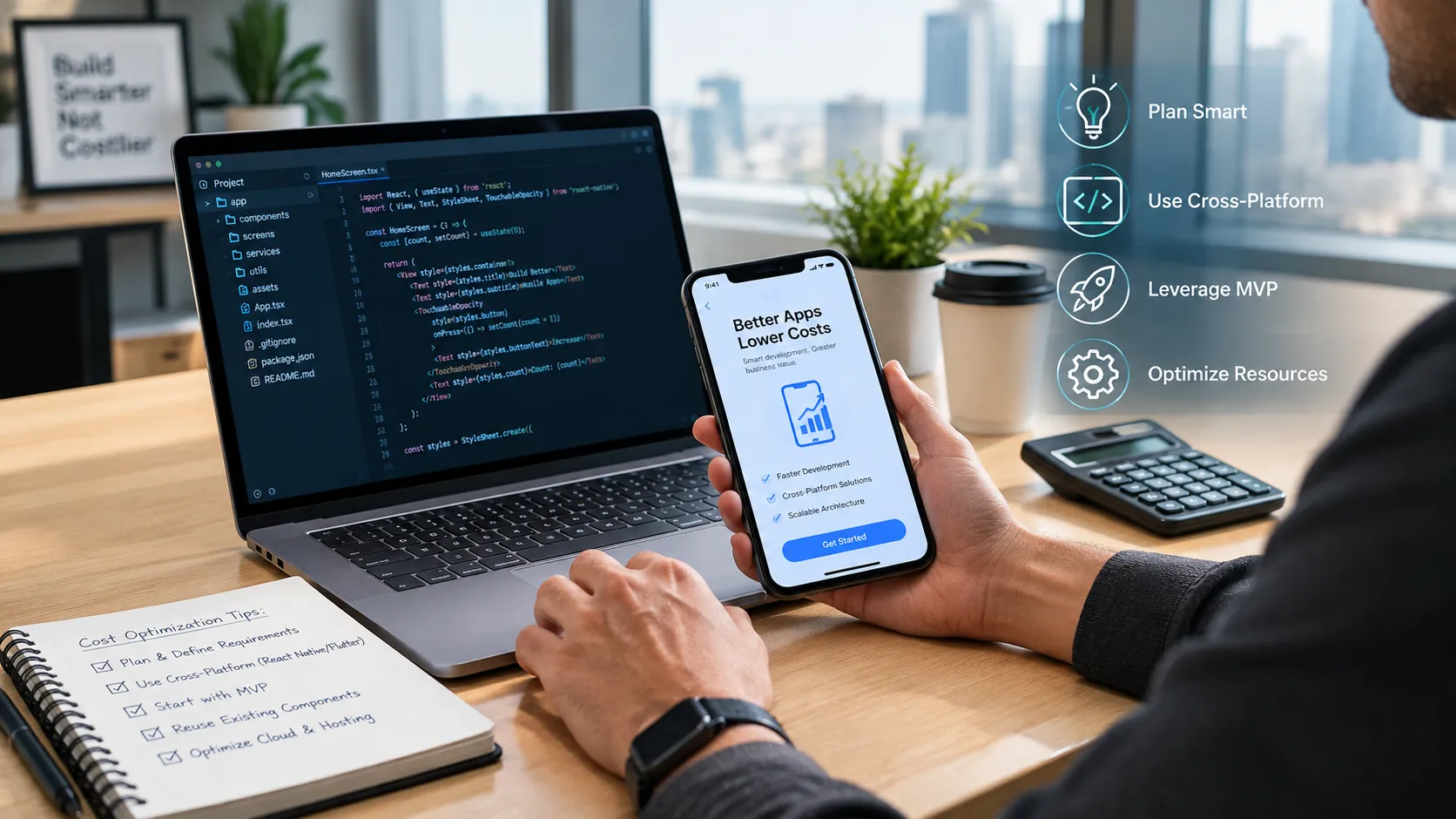
Shared codebase development building for both platforms from a single codebase using frameworks like Flutter or React Native reduces certain cost categories meaningfully when applied to the right type of project.
The cost categories it reduces are real: one development team instead of two, one codebase to maintain, one release pipeline to coordinate, QA that covers shared behavior once rather than platform-specifically twice. For apps where the experience on both platforms is similar and where performance-critical native features aren’t central to the user experience, these savings are genuine.
The cost categories it doesn’t reduce are also real: platform-specific behavior still surfaces and needs addressing, performance-critical features sometimes need native implementation anyway, and the overhead of a shared codebase framework isn’t zero. Teams that treat cross-platform as automatically cheaper than native without evaluating the specific requirements of their project sometimes discover that the savings were smaller than projected while the constraints of the framework were larger.
The projects where cross-platform produces the clearest cost savings: business logic-heavy apps with straightforward UIs, internal tools where platform fidelity is less critical than feature coverage, and apps where the primary platforms share most of the required functionality. The projects where native is frequently worth the additional cost: apps with complex animations, camera-intensive features, or platform-specific hardware integration where the framework’s abstraction layer creates performance ceilings.
Design Investment That Reduces Development Cost
Counterintuitively, investing more in design upfront tends to reduce total development cost rather than add to it.
The connection between design completeness and development speed is direct: engineers building from incomplete design specifications make design decisions during development, and design decisions made during development are more expensive to change than design decisions made before any code was written. An edge case that a designer resolves in thirty minutes during the design phase might require reworking three screens of code if it surfaces during development. The same edge case surfacing during testing might require changes that affect multiple interconnected features.
Complete design specifications define every screen state empty states when there’s no content, error states when something goes wrong, loading states while data retrieves, edge case layouts for unusual content lengths. Teams that receive complete specs build more predictably than teams that receive key screens only. The additional design investment pays back through reduced development back-and-forth, fewer mid-sprint scope clarifications, and lower bug counts related to undefined behavior in states the design didn’t address.
Reusing What Already Exists
Mobile app development cost are significantly affected by how much of the required functionality needs to be built from scratch versus how much can be assembled from existing components, libraries, and services.
Authentication is one of the clearest examples. Building a secure, well-tested authentication system from scratch handling credential storage, session management, multi-factor authentication, social login, account recovery is substantial work. Integrating an established authentication service like Auth0, Firebase Authentication, or Supabase takes a fraction of the time and produces a more secure result, because these services have been hardened against attack patterns that a from-scratch implementation would need to discover independently.
Payment processing, mapping, push notifications, analytics, cloud storage, video streaming in most of these categories, established services exist that are faster to integrate than to replicate, and that have been tested at scales that a new product isn’t likely to reach for years. The cost of these services is real and ongoing, but in almost every case it’s lower than the engineering cost of building and maintaining equivalent functionality.
The apps that get built most cost-efficiently are the ones where the development team has made deliberate, specific decisions about what to build and what to buy integrating services for functionality that services do better, and building custom only where the specific requirements genuinely exceed what available services can provide.
Testing Strategy That Prevents Expensive Late-Stage Fixes
The cost of fixing a bug scales with how late in the process it’s found. A bug identified during development costs the time to fix it. The same bug identified during QA after development costs fix time plus the regression testing required to verify the fix didn’t create new issues. The same bug found in production costs all of the above plus the customer impact while it was live and the reputational cost of the failure.
Automated testing written alongside development unit tests that verify individual components, integration tests that verify components work correctly together catches bugs at the cheapest moment. The upfront time cost of writing these tests is real and the payback comes in reduced bug discovery costs later, particularly during the ongoing development that follows initial launch when changes to existing code frequently introduce regressions that automated tests catch immediately.
Manual QA across a meaningful range of devices before launch is also an investment that prevents expensive post-launch fixes. The bugs that surface when an app runs on an older device with less memory, or on a specific manufacturer’s Android skin that handles permissions differently, are the bugs that generate one-star reviews from real users and require emergency patches under pressure. Finding them in a pre-launch test environment is considerably cheaper.
The Cost Framing That Actually Matters
Mobile App Development Cost is frequently evaluated at the initial build level how much does it cost to ship version one. The more accurate framing evaluates total cost of ownership across the life of the product: build, testing, launch, ongoing maintenance, platform updates, feature additions, and the inevitable refactoring when early decisions need revisiting.
Choices that reduce initial build cost sometimes increase total cost of ownership significantly. Skipping automated testing saves upfront time and increases the cost of every subsequent change. Building a monolithic architecture that’s fast to produce initially makes future scaling expensive. Choosing the cheapest development team regardless of experience level saves on day rates and sometimes requires expensive remediation work later.
The strategies described here focused scope, appropriate platform sequencing, selective use of cross-platform tools, complete design before development, service integration over custom builds, and upfront testing investment reduce total cost of ownership rather than just the sticker price of the initial build. That’s the cost reduction worth pursuing.